The Crow Collective

Latest on The Crow Collective

Read the latest posts from The Crow Collective.

from Ari's Repository

Or, How I Learnt to Stop Worrying and Trust the Paper

Ever since I returned to full time freelancing (after being refused disability benefits by the government of Saskatchewan), I've found myself feeling increasingly overwhelmed by all the spinning plates. Freelancing in the graphics and media industries in 2026 is, more than anything, an exercise in balancing many executive tasks at once.

Whether it be the increasing demand on low-tier freelancers to be marketable, or the ever-widening income gap created by GenAI further devaluing graphics skills, it’s a harder time than ever to be a freelancer. Now, instead of “simply” fighting against large scale design firms who can undercut us as freelancers, we are also working to pry our clients away from middling Generative AI designs. We must not only demonstrate our financial worth but also advocate for the essential role of human touch in design language. I've found myself needing to divest more of my time from the actual creation of the work and place more and more emphasis on, put bluntly, client acquisition and relationship management.

Don't get me wrong, I absolutely adore meeting new people and catching up with my clients. There is nothing better in the world than being able to learn about my clients and connect them with each other where it would be helpful. There's something so intensely satisfying about being the person who knows the people, the “I Got A Person For That” person. Naturally, this leads me to working on many projects at once, and keeping track of that can get a little messy. Between photography clients, artistic endeavours, music production work, community work, live performances & event planning, and personal life, it can be too much to manage at times.

Back when I was working for a busy non-profit office I tried to invest in digital management solutions. I was sold on the promise of “offloading your mind to a secondary brain”. I bought into the iPad ecosystem (twice!), absolutely certain that I’d be able to replace my trusty bullet journal. Finally, I thought, I can fully interface my digital life with my freeform bullet journaling! Well, after nearly 6 years of giving it a go, I’m finally going back to maintaining a proper journal.

A black and white photo of an old journal

What's not working?

What exactly did I try, and what were the flaws then? How did digital organizing tools fail to achieve what a simple pen, journal, and ruler could do? Doesn't that feel a little, odd?

So, what were the “must have's” for a solution to be successful:

  1. First class handwriting support (handwriting recognition optional)

As an avid stationary enthusiast and someone who has developed and learnt a number of shorthands, being able to handwrite something when I need was an absolute must. Even tho I am able to type between 90 to 120 wpm and handwriting takes much longer for me, it still feels easier to translate my thoughts with a pen.

  1. Ability to mix links, text, and images in-place alongside handwritten content

One of the big shortfalls of my classic journalling practices was being unable to easily include things like photos and links to digital resources. The more professional I became, the more often I needed to reference digital drafts and documents. Especially as I fell deeper and deeper into the freelance web-design rabbit-hole.

  1. Ability to quickly navigate and discover notes and knowledge

My bullet journal, with the practice of striking out unneeded or outdated information, became one of the best discoverability tools I had in my professional toolbelt for a number of years. Every so often I would find myself with some spare time and idly flip through the pages of my journal. This slowly became a way to find projects and tasks that had slipped through the cracks, and kept me honest. Any solution should help me find information, not hide information away.

Next, lets give a quick overview of the various digital tools I tried:

1. Apple Notes

Apple Notes, while being one of the more flexible and reliable solutions that I've tried, experienced just enough bugs and input lag to be frustrating. The handwriting recognition, while very helpful at times, mostly functioned as a drain on my battery when in a full work day. While in most cases I wanted to disable the feature, being able to scribble somewhere on “the page” a simple hashtag and add the note to a cloud of related information was too good.

The Pros:

The tight integration with iPad OS – which itself is tightly integrated with my daily driver MacOS – was a major benefit. Being able to tap a blank, locked screen and have a new “piece of paper” appear that supported whatever kind of scribbling I wanted was very helpful. It felt like having an infinite legal pad sitting beside me, especially with the iPad mini (6th Gen). As mentioned above, being able to scribble a hashtag onto the screen to “file it away” felt very close to an ideal workflow. Additionally, the text and media mixins were workable for using as a light assistance to my previously existing bullet journal workflow.

The Cons:

Strangely enough, the number one issue that I continue to run into across all of the software that I have tried is the lack of fixed page ordering. Sure, I could create folder structures and auto-hashtag filters and all kinds of neat auto-sorting like you would expect from a digital solution. Unfortunately, no matter how I tried to organize things, it just never clicked. Finally, it worked just consistently enough that bugs were incredibly frustrating. If the bugs happened 1 in 5 times, for example, it would be annoying but predictable. When it happened 1 in 15 times, it was workflow-breaking.

2. Apple Freeform

Apple Freeform, in opposition to Apple Notes, really gave me the ultimate freedom I needed to really map out my mind on any given task. It felt very powerful to be able to continuously paste more and more information onto a board and treat it like a giant flow chart. However, when trying to organize the boards, they are just too data heavy to be able to move around and keep synced between devices rapidly. This, in my multi-device life, was a big deal breaker.

The Pros:

It did what it said on the tin: enabled freeform idea creation on a whiteboard like surface. That's about the whole list.

The Cons:

As mentioned above, I spend a lot more time waiting for Freeform to sync than I care to admit. I don't know if the files are just large or if Freeform just doesn't get much bandwidth on iCloud, but it was just too slow. Further, as mentioned above, there wasn't really any good way to organize information across specific topics – aside from having one giant board.

3. Goodnotes

Goodnotes positions itself as the next step after Apple Notes (or other respective on-board note apps), and largely delivers on this promise. Goodnotes creates digital journals that have a single sequential numbering with freeform handwriting/typing support and digital content embedding. No hashtag support in this one, nor any linking from one note to another, but ultimately a very good option for those wanting to try the whole digital journal life!

The Pros:

You can maintain an index as if the journals were a binder with pages that can be moved from one position to another. Input flexibility was fantastic, allowing fluid mixing of handwriting, text, images, and links. Furthermore, it had a number of fantastic writing assists. Finally, unlike Apple's solutions which render the same “page” at different sizes depending on different devices, Goodnotes defines a specific page size that will always represent your elements at the same size.

The Cons:

While Goodnotes ended up as my primary digital solution after exploring the landscape for a number of years, it still didn't quite fit the bill. I utilize the page number of a journal as a reference point between different notes – allowing quick reference between varying ideas. This workflow became severely disrupted without strict personal adherence to it, which I’d much rather avoid spending my energy on. Goodnotes now functions more as a digital binder than it does a single journal or point of reference.

4. Craft Docs

Craft Docs, while I was using it (2021-2023), felt very much like if Obsidian and Bullet Journaling had a baby and spawned a handwriting-first backlink-capable note-taking and document building platform. At first, I was in love. Over time the high price per month subscription cost became too much to bear. It felt like paying a premium for paper, and I couldn't stomach it. While Goodnotes also has a paid subscription model, I was able to get by on the unpaid product. Craft Docs felt different. I've heard the subscription model has become much more approachable, but I still like paying once for a book and not having to think about it. It may warrant further exploration in the future.

The Pros:

Wonderful support for Obsidian like handwriting workflows wherein you could embed a “whiteboard” into a note, and potentially embed “whiteboards” inside “whiteboards.”

The Cons:

While incredibly well featured it became more distracting than useful, with too many fun ways to play with it. Furthermore, while the platform had fantastic potential many of the features felt half-baked (at the time). This platform had considerable promise, and may warrant a revisit in the future.

5. A host of free apps

Frankly, I've tried too many to list here. Ultimately, it always came down to a few simple issues. Namely, archive stability, app stability, and the promise of availability in the future.

The Pros:

They were free and they were varied.

The Cons:

By and large, it felt like the ecosystem of free writing recognition apps was just not where it needed to be. Ultimately, more than anything, too many of the apps that I tried were shuttered while I was experimenting with them. I really value that I can still go through my old journals when I need too, so this was a huge dealbreaker.

So why bullet journaling in 2026?

I’ve tried a plethora of solutions. I’ve adapted workflows, created organizational systems, and put these tools to the test. However, they just conflicted with something deep down within me. I think, perhaps, it might relate to learning how to organize my thoughts in traditional composition books all the way back in grade school. Bullet journalling, with its heavy use of index numbers and jumping about the book, makes great sense to my brain. It feels natural, almost like flipping through school binders like I did in university; familiar in a primal way.

This logic continues for me. Digital solutions are relatively new in the grand scope of human experience. I think there is a very simple reason why so many corporations are trying to create paper-like experiences for their digital products. I believe it’s because they have stumbled across the same thing I am trying to elaborate upon in this blog post: humans have spent thousands of years refining how to collect, produce, and archive knowledge using tools like paper and pen. My grandmother used paper to collect family histories. My grandfather’s grandfather used paper and pen to preserve music beyond tradition. I come from a lineage of people who have formed primal connections to books and bound volumes of human experience. Perhaps one day digital solutions will eclipse the reflexive knowledge built into my body through generations of tradition, but I do not believe that day has come for me.

Bullet Journalling, then, would be the ideal solution to return to for me. I’ve already poured hundreds of hours into refining my own personal journalling system, and reflexively recall advanced cataloguing structures that I have honed over those many hours. Furthermore, there is a large community of people loosely following the Bullet Journal practice who regularly share their ideas on how to further your own personal system. Earlier in this post I wrote about falling into the idea of “offloading my brain” to a digital solution. Well, it turns out, I had already been developing those reflexes and systems for years via my own bullet journal practice. After nearly 10 years of Bullet Journalling on and off my system has been reduced to a simple single-pen solution that can be made highly flexible and portable. It feels rewarding every day to open up my journal and practice mindfulness by reviewing the last day so as to structure today.

Integrating both solutions

The problem then, with embracing paper and pen solutions, is that my original issue tracking digital and visual information within the journal continues – does it not? Well, that remains true. Ultimately, I don’t have a good or concise way to include direct links to digital assets. Perhaps one day I might invest in a QR code printer that i can fit in my purse alongside the journal. However, in the now, that is just one more expense to maintain. As a digital media freelancer, every cost I can save is savings I can pass on to my clients.

As I already have a number of various solutions on both sides of this coin, why not integrate them? What happens when instead of trying to include direct reference into my journal of digital assets I instead flip the idea on its head. Why not use a platform like Obsidian to mark where in each respective journal associated information is tied too? What happens when I utilize an app like Apple Freeform to turn my iPad mini into a little window into a giant whiteboard that I can take wherever I might need? What if I treated my digital handwriting tools as the ephemeral notes that they are, like notes on a legal pad?

It’s a little too early in my return to bullet journalling and my attempts to hybridize my classic journal workflow to pass judgement. However, I remain optimistic about this current solution. Stay tuned for more in a few months!


Ariana Giroux

Situated in Treaty 4 territory, Ariana Giroux is an award winning advocate, photographer, and musician. As a self taught photographer, their practice is centred in her trauma informed, queer, and trans way of knowing. Through an experimental lens, she aims to capture the nuances inherent in the experience of living a queer and radical life.

Regularly working with clients from many diverse backgrounds, Ariana spends her time building community and seeking the best cup of coffee.

Find more of her work via her littlelink.
 
Read more...

from Photography

For the last couple months I've been hard at work developing my photography practice. It's my goal to make at least one photography project a month. I've been shooting professionally since 2024, and it has been such an amazing journey. While I have been hard at work maintaining an events and portraits photography practice, I've been thinking about how to return to the artistic outlet that photography provided when I first started.


For the impatient, subscribe here!


As a photographer in a province where nearly half of the year is too cold to use my current gear outside, the idea of building a creative practice that survives year round has been difficult to sort out. Between the lack of weather sealing on my camera equipment to my own relationship with chronic illness during the winter months, I found I needed to dust off my skills when the snow began to melt. Saskatchewan is famous for its temperamental winter weather, so much so that a colloquial saying is a parody of Mary & Pippin from The Lord of the Rings Series:

“We've had one winter, yes, but what about second winter? third winter? what about fourth winter?” “I don't think the rest of 'em know about fourth winter friend...”

A photo of me from 2020 wearing 4 layers of winter gear. You can just make out my hair, eyebrows, and eyelashes being frozen. A photo of me from 2020 wearing 4 layers of winter gear. You can just make out my hair, eyebrows, and eyelashes being frozen.

Building a year round photography practice

While I do consider myself very lucky that people continue to hire me to do photography and A/V services for events and shows throughout the winter, I often feel my creativity shifting away from photography. This past winter I built the whole Crow Collective technical infrastructure – from this blog platform to mass file storage. However, I've been finding it hard to do photography over cool code and tech stuff.

My solution? Monthly pocket zines!

A photo of the first zine, with camera and SNES sized controller for scale A photo of the first zine, with camera and SNES sized controller for scale.

I've made a number of zines in the past using my photography, and it's always felt strangely powerful. There is something about making quick layout choices for a printed “book” to elevate the work from photos to a story. I've played with zines as photo essay, wordless portrait books, and literary explorations of queer politics. So, to hold myself accountable, I've started building a little bit of a backlog of zines that I can release. However, I started having so much fun that I had too many to know what to do with!

Enter the Zine Club idea! I figure because they can be mailed in a standard letter, and because they cost so little to produce, why not offer them up monthly as a delivered to your door art service! It feels like a novel way to cut through the noise of the online photography space (namely, instagram). Photography as a medium becomes elevated to something else once it is made physical. Holding a photo or an album connects to all of our senses, allowing us to engage much deeper than a scroll and a double-tap like on instagram.

A black and white photo of 2024's "Transcend" zine which documents the 10 year anniversary of the passing of human rights protections for trans people in Saskatchewan. A black and white photo of 2024's “Transcend” zine which documents the 10 year anniversary of the passing of human rights protections for trans people in Saskatchewan.

Since the beginning of my photography journey, I have always been fascinated by the ways in which it can be a tool to preserve. Whether it be the photos of a lover who tragically passed away or the joy in the eyes of someone truly being themselves, I am fascinated by the idea of leaving those moments behind for the next generation. The invention of the photograph and handheld camera democratized the question of “who gets to preserve or document” more than ever before. Conversely, the prominence of photos now being something that exists behind our screens has made it harder than ever to truly usher something into the world. The zine club, then, is my personal resistance against the modern age of photography, and a way to embrace a more personal and forward thinking way of being.

So join me as I explore what it means to document, preserve, and uplift queer and trans lives and joy. Every month we will explore new topics from radical queer politics to broad visual themes. There are only 20 slots available, so join quickly!


If you find yourself interested in signing up to receive monthly pocket zines on a number of topics, consider subscribing via ko-fi using this link!

*Memberships only cost $5CAD/month, and go directly to supporting queer and trans work! Only 20 slots are available, so act fast!*


Ariana Giroux

Situated in Treaty 4 territory, Ariana Giroux is an award winning advocate, photographer, and musician. As a self taught photographer, their practice is centred in her trauma informed, queer, and trans way of knowing. Through an experimental lens, she aims to capture the nuances inherent in the experience of living a queer and radical life.

Regularly working with clients from many diverse backgrounds, Ariana spends her time building community and seeking the best cup of coffee.

Find more of her work via her littlelink.
 
Read more...

from Photography

Or how I learnt to embrace quiet intimacy in photography.

So it's pride month again, eh? As has been tradition for the last couple years, I've pushed myself to get out there to as many events as I could to document them with my camera.

A progress pride flag waving in the wind from a flagpole.

I've previously been involved in many aspects of queer organizing, including but not limited to being directly involved with my local Pride Board as a board member. Earlier this year I resigned my on again off again board role with TransSask Support Services, marking the last leadership role I find myself in officially within the community. My resignation was in part due to my own failing capacities, but largely came about because it was time for new blood to take the helm. I've been directly involved in the non-profit power structure of Saskatchewan and Treaty 4 for over 10 years – it's time for new ideas.

However, after over 10 years of organizing queer and trans resistance and resiliency, I find myself growing restless if I don't contribute something to “the movement.” When planning this post, I spoke with the aforementioned “new blood” (my colleague known online as “HootOS”, “Roadie”, or “Hoot”) about her own role in her city of origin's local Pride movement. 10 years ago she worked alongside a number of provincial organizations to have pride month officially recognized by the city of Estevan – as well as an official flag raising. The tradition of Pride organizing has continued and survived to this day, even beyond her own personal input. It shared its own insights on the importance of queer history and its place within it. We discussed the question of preservation and who gets to preserve. And finally we shared our own respective histories of the people and bonds that got us to where we are today.

A sign language interpreter plies their trade in front of the Queen City Pride banner.

This got me thinking about the legacies we build and leave behind as queer people. All too often our history as queer people is as ephemeral as teardrops in the rain. I find it interesting that I have had my own hand to play in the queer/trans history of Saskatchewan that continues to unfold around us every day. In my conversation with Roadie, I found myself repeatedly speaking about actions and relationships from well before my own time. A verbal history that is uniquely my own, that is inseparable from my own perspective. Then we discussed the actions I had a hand in between 2020 to 2023 that laid the seeds of what we as a community face today. And more than anything, I lamented that so much of that history that I keep in my heart is lost to the winds.

What role do I have to play in preserving this history? What role can I play as a photographer? How does the choice I make when I point my lens at a subject impact the history that lens preserves? What does it mean to take photos of a disempowered community that so often does not get to choose how it is represented? I've been actively wrestling with these questions ever since I picked up a camera. Some of my earliest work I consider worthwhile preserving was taken explicitly to document a protest in Prince Albert. One of the reasons I wanted to get into photography in the first place was to document the struggles of my community.

A protestor holds up a yellow sign with handwritten black text that reads 'Regina Cops Hate Queer Kids'

As time has gone on however, my focus has shifted from preserving the moments of hostility and struggle. I do not find power in documenting the police surveilling a protest. I do not find purpose in documenting a politician failing to serve our community. Instead, what else can I explore with my lens? What stories can I tell with my camera that uplift? How can I use my photography to will into the world genuine kindness between strangers? I find myself constantly coming back to one singular question:

What story will my photos tell after I am gone?

After 10 years of working with and for the queer/trans community, I have learnt one truth over all others: it is not in moments of grand resistance that our futures will be made, but in the quiet moments of service and resilience. In my heart, I do not believe that the greatest impact an individual can have is through major political actions like protests and displays of civil dissent. Instead, I believe it is in the building of networks of care and support. I believe it is in the quiet sharing of love between partners and found families. You can find it in D&D nights and coffee dates and Drag Shows. You can find it at the gay bar or at the library. Any one place where two people dare to be themselves in a genuine way.

Two young people are showing each other affection, while a large sun-bleed slightly obscures their faces.

I find my photography has slowly shifted itself to reflect this internal dialogue that I have been having. While I do still try to take heavily politically motivated photography (see below), I find myself being much more drawn to small moments of intimacy and resilience. Street photographers often discuss their “photography triggers” (that is, what makes draws you to a photograph), many find themselves drawn to moments of action or intrigue. I however find myself drawn to moments of stillness amongst the chaos of a busy event. When I'm out on the street day to day taking photos, I try to take photos that remind me of the community I live in.

My politics now inform my photography more than they ever have. More than when I focused on taking provocative photos that forced the viewer to reckon with its content. Now I am much more interested in photographs that draw the viewer in and encourages them to ask questions. Why this moment? Why this frame? Why did the photographer choose to include this event? With the photo below, I felt there was great power to be found by including the police officer standing by at the flag pole. To have an officer of the law placed prominently behind a trans woman without any identifying features is to place them in a position of subservience. I was able to use this moment to raise greater questions about the inclusion of police in our communities.

HootOS stands in front of a police officer, speaking to the crowd with a  pride flag in her hat.

However photos like the above represent such a small sliver of what the totality of our existence is as queer/trans people. Yes, our lives are so often monitored and policed – both literally and figuratively – by people who would rather we all just... went away. But our lives are also so filled with joy and love that so often lies under the surface.

So I began focusing my efforts less on traditional documentary street photography and more directly on impromptu portraiture. There is just something so truly magical about asking someone you might not know if you can take a photo of them. Building that connection, if even for a moment, can create such beautiful work that better represents the people in the community. And after all thats my goal, isn't it? To accurately represent my community?

A person wearing a boxhead cosplay and a bi flag as a cape poses for the camera.

As I continue to develop and mature as a photographer since my start in late 2023 and 2024, I find my work has continued to develop a more personal touch. As I continue to review my photography from time to time, I notice consistent trends amongst the work. Whether it be my apparent love of multi-generational candids or the eye for deep contrast and still frames, it all seems to lead to a singular nexus:

My photography is my way to shed light on the quiet, resilient moments of life as a disabled Metis transfemme and her community.

As my conversation with Roadie illuminated, there is power in preserving our stories. As I have discussed above, there is real world value in creating a record of “the movement” that preserves the truth of our community. Not a truth based in violence and oppression, but in love and generosity and connection. Since time immemorial queer & trans community has always focused on these primal points of connection between individuals and communities to survive and – most importantly – thrive.

I want to do my part in upholding and evolving that tradition.

A young person smiles at the camera, ready to carry the torch


Additional photos are available on my photography site via the following public galleries:

  1. the Regina Pride Flag Raising Ceremony photo gallery
  2. the Gaza Benefit Pride Show photo gallery
  3. the Regina Pride March photo gallery
  4. the Estevan Pride March photo gallery

Stay tuned to my portfolio site over the coming months for even more pride and street portraiture! There is more pride yet this year!


Ariana Giroux

Situated in Treaty 4 territory, Ariana Giroux is an award winning advocate, photographer, and musician. As a self taught photographer, their practice is centred in her trauma informed, queer, and trans way of knowing. Through an experimental lens, she aims to capture the nuances inherent in the experience of living a queer and radical life.

Regularly working with clients from many diverse backgrounds, Ariana spends her time building community and seeking the best cup of coffee.

Find more of her work via her littlelink.

 
Read more...

from Collective Announcements

We've been hard at work here within The Collective working on a number of new projects. We are excited to key you – dear reader – into those projects!


Up first, let's check in with CC-Ari!

Emi: So you've been hard at work on a number of software solutions. Tell me about that!

Ari: Yeah! I've been working on picking up and familiarizing myself with the Go ecosystem! I've been hard at work rewriting an old interface I made in Python for the Poormans Issue Tracker, which will provide simple & flat file issue tracking solution.

Emi: A flat file... huh?

Ari: Right. A “flat file data structure” is a method for storing relational data (that is, data that relates to specific things) where one file describes one segment of data. In the context of an issue tracker, this would likely include things like a status file that describes the status of the issue and a description file that contains a long-form description of the issue. Simplified even further, these files should be plain-text files that contain raw data.

What this means to a user is that, to read a flat file issue (as described by the the Poormans Issue Tracker), a user simply reads the a directory name as the title of an issue. Then, they can read the contents of status and description for more information on the details of said issue. The spec also defines a standard for tags and blockers, but those are beyond the scope of this conversation.

Emi: “Beyond the scope of this conversation...” Has anyone ever told you that you talk like a programmer?

Ari: *laughs* Yeah, that doesn't surprise me. I have a hard time pulling my head down from the clouds when I'm talking about computer tech.

Emi: So what drew you to this problem?

Ari: Well, like I said, this is primarily a way to learn the full Go(-lang) lifecycle. I started off re-building a simple ping charting software that is a standard programming exercise I do in every language that I try learning. You can check out that code over on our git repository. I find it useless to try to learn a programming language without solving a real world issue – and Issue tracking is an ongoing headache of mine.

Emi: For those of us in the collective who don't look at code repositories all day, what do you mean by “Issue Tracking.”

Ari: Okay yeah! Ehm... So you've likely downloaded something off GitHub before (for example). Maybe a mod, maybe a software, who knows. But you might've noticed the “Issues” tab. This is designed for users to report back bugs, software failures, and all sorts of things relating to the software. Open source software thrives on user reporting. Because most open source projects don't have funding to employ a team of testers like most corporate software, bug fixes simply cannot happen without user feedback.

The problem is that GitHub's implementation of issues requires an end-user to log in and provide information like emails/passwords/etc. This bothers me. I don't want my software to require users to expose themselves/trust me with sign-in credentials just to tell me that there is a problem with my code. I feel like the idea of 0-trust issue submission/reporting is a useful tool for obtaining feedback on your software.

Emi: Isn't GitHub owned by Microsoft?

Ari: Yep! And I don't feel like feeding my code and my insights directly into their GenAI bullshit that is actively ruining software efficiency by the day. Why should someone have to burn who knows how much electricity just to tell a software maintainer that it breaks?

Emi: So, you're trying to create an alternative to this? Are you hoping to influence the open source software community?

Ari: Yes, and no. My goal is to create a simple solution that does not require multiple sets of server technologies just to run. Because issue tracking software is not domain specific to coding, this software is not meant solely for coders. As such, it will never ship with tight git integration or pretty web-servers. The goal is to ship a binary that teams can use to generate a consistent set of data and browse said data (via a TUI). Additionally, a future feature is to implement a simple ssh-style application for managing a central repository of issues (that can be checked out as a git submodule).

So is this something I hope makes waves? Not really. Ultimately higher-tier issue tracking solutions like the aforementioned GitHub implementation have their use cases. A simple repository of flat text files and folders and a binary that does not concern itself with users or authentication does not make for a good solution for mid-size teams and up. I just want to make something that works for us as a collective, and that others may be able to use for themselves.

Emi: Okay so how would I use this software?

Ari: So, on release (it’s still in private development), a user would be able to either grab a binary from our releases page, or build from source using Go. Go is a fully portable language, and can cross compile for any architecture so we will be providing pre-compiled binaries for every major modern architecture.

Once you obtain a binary, it has a simple CLI and TUI for browsing, creating, and managing issues. It is our aim that a non-technical user should be able to make use of the project without any knowledge of command line interfaces.

Emi: So when can we expect it to release?

Ari: Well, I’m currently hard at work finalizing the TUI and data lifecycles. Next will be a simple CLI interface, and then ensuring that tests run effectively. At the pace I’ve been going, I would expect release sometime in the next month or two.

Emi: Well that’s exciting! I can’t wait to hear more!


Up next, let’s check in with Nim!

Emi: Nim, when are you gonna get around to making a blog here?

Nim: Oh god don’t pressure me! I’ll get around to it when I have things to post!

Emi: Fine fine, just bugging you! So. You’ve got some news eh?

Nim: Yeah! I’ve been working with CC-Ari on her DJ kit, and I’m super excited to say that we are going to start streaming DJ sets again!

Emi: Oh thats exciting! What’s bringing Ari back?

Nim: I mean, we’ve been talking about what would go wrong with her old live-stream sets. Realistically it truly came down to a dis-satisfaction with her stream setup and streaming space. It took too much energy for her to set up and tear down every day, as there wasn’t a permanent place to keep her rig set up!

So that’s where I come in! I’m working on updated graphics, stream interactions, and a permanent set up for her rig! I’m going to be stepping in as a stream manager, as well as (hopefully) roping in our good friends over at HootOS to help with the workload!

Emi: Amazing! I can’t wait to groove to the streams again! Will you be streaming anything yourself?

Nim: We’re working on how we want to present a collective wide streaming presence, but yes. I do hope to start doing some gaming streams as well as general art streams!

Emi: When do you expect the channel to be live for that DJ stream?

Nim: We’re working on getting it up and running by sometime mid June.

Emi: Well I can’t wait to see it!


That’s all we’ve got in the pipe right now, but be sure to stay tuned to our site!

 
Read more...

from Emi (she/they)

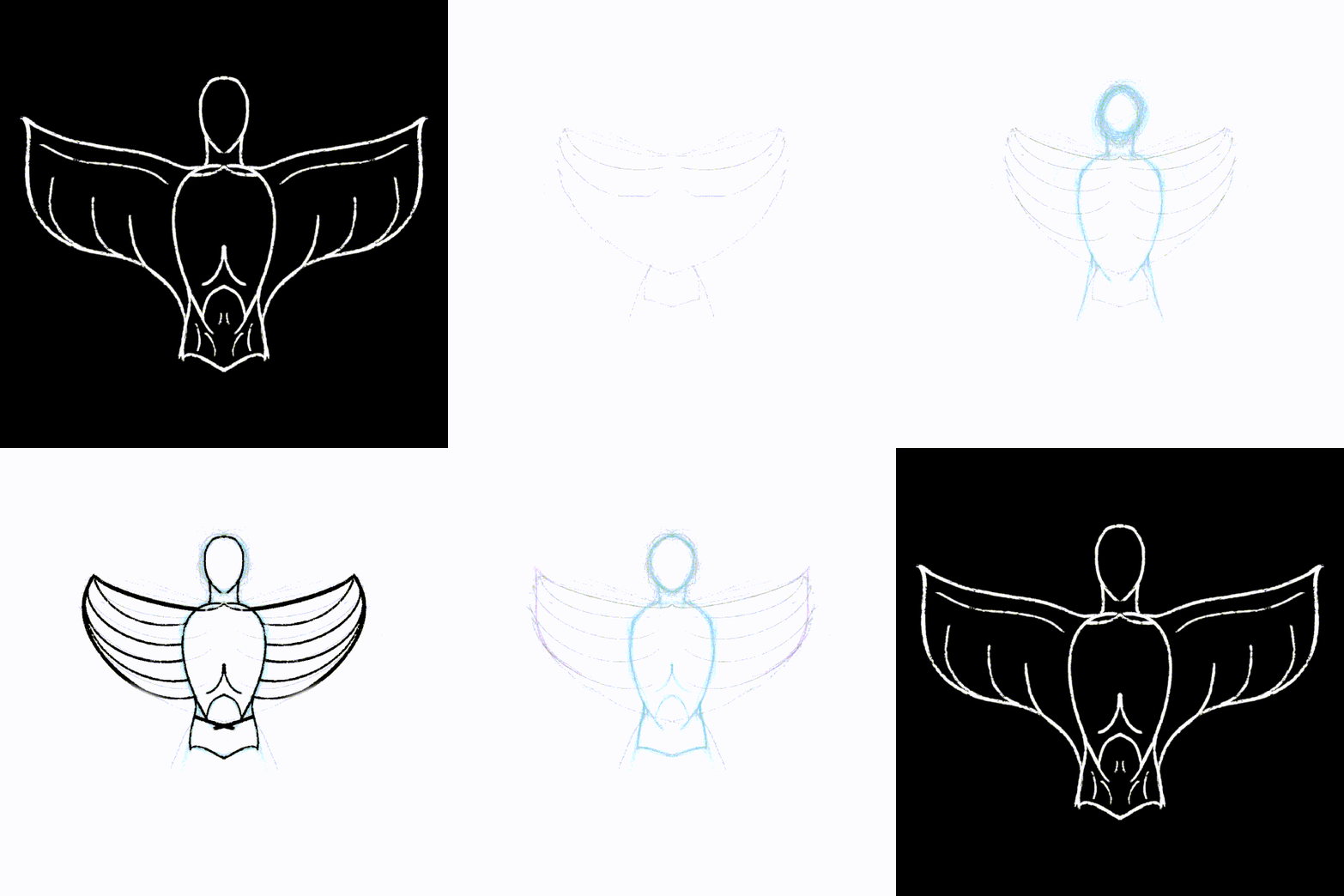
Recently, we've been working on the homepage for The Collective, which naturally entails needing graphic design assets. We've been hard at work fleshing out the site with a status page, our git repository, and much much more... but a homepage felt the most important.

We're excited about the future here at The Crow Collective. It sure feels bright with so many possibilities open to us. We could release new music, maybe write a photo essay, potentially even make a game? There are so many options that it felt good to have one thing to focus on.

Anywhos, on to the meat and potatoes. In this post we will be discussing the how's and why's of the choices we made with the design. Keep reading to learn more about our logo!

Design & Development Methodology

Unlike the majority of the design work that the collective has, largely under Ari's purview, this design started with a sketch in Procreate.

A Timelapse of the sketch being drawn.

While generally speaking we as a collective strive to use open source software where we can, this is not a hard and fast rule. We believe it's important to decouple ideology from practice when it comes to accessibility and tool choice. Ultimately, Procreate was cheap when Emi bought it and continues to be one of the most simple design softwares she has to work with. It is vital to us that our members make the choices that feel best for their body/minds. Procreate continues to be worth the investment time and time again to Emi.

Once we had a sketched out idea of what we wanted to make, it was time for Ari & Emi to collaborate on the vectorization. Ari has been wanting to try out the new offering from Affinity (previously Affinity Designer), especially since it moved to a “forever free” release in partnership with Canva. Ultimately, we aren't too happy with the AI shovelware being forced into the software, but we are glad to have all of our design needs in one place. None of us had ever worked with Affinity's vector graphics offerings previously, but we found it relatively intuitive for the simple use case we had. The “jury” is still out on the new software, but we will be sure to keep you – dear reader – posted!

Design Ethos

Emi's perspective

I had a number of goals and priorities going into this project, all centred in my best understanding of non-western/non-colonialist visual design language. It was important to me that this design represent my own journey in coming to understand myself as a person of metís and indigenous heritage. I wanted to go about this design in a good way that honoured not only this heritage, but the privilege I hold in being able to go until later in life without knowing about it. Therefore, I avoided using any specific design elements, and instead focused on a vague merger of organic geometry and fluid brush-strokes.

Furthermore, the iconography of a crow has many meanings both for the collective as a whole and me specifically. Corvids are incredibly loyal to those who treat them with respect. We've all heard stories of corvids and crows bringing gifts and trinkets to people who treat them like the friends they are. Crows and corvids aren't just smart, they exhibit a wisdom I feel we could all learn from. Crows are regularly observed utilizing their environments to create tools and manipulating them to their own benefit. Crows carefully plan ways to better their surroundings, building community with even those beings completely unlike them.

Collective perspective

We as a collective chose crows to embody our ethos because of their resourcefulness. A bird often associated with death and decay, crows are vital to their respective ecosystems. Crows build partnerships, design systems, and exist within their environments – not despite them. We value these traits. As a collective it is our goal to slowly foster liberationary relationship building both with those we engage with through our work and as an ethos and way of being for all.

The fluid brush strokes of the piece complement our values of natural and sustainable growth. By being free to travel where they want to go, not where they would be expected to go. As a crip/mad collective, we wanted our logo to represent the ways in which our lives must remain ever in flux – waxing and waning with the tides of our symptoms. Where a more traditional design may stray away from fluid/thin lines for readability sake, we wanted to explore just how much we could get away with.

We had very few “requirements” that we reached as a consensus, and one of the only ones was the use of organic geometry. We felt that straight lines and hard angles were antithetical to the queer weirdness of our lives. Hell, it says it on the tin: “straight lines” just aren't something we are very good at. Emi did a fantastic job on this front.

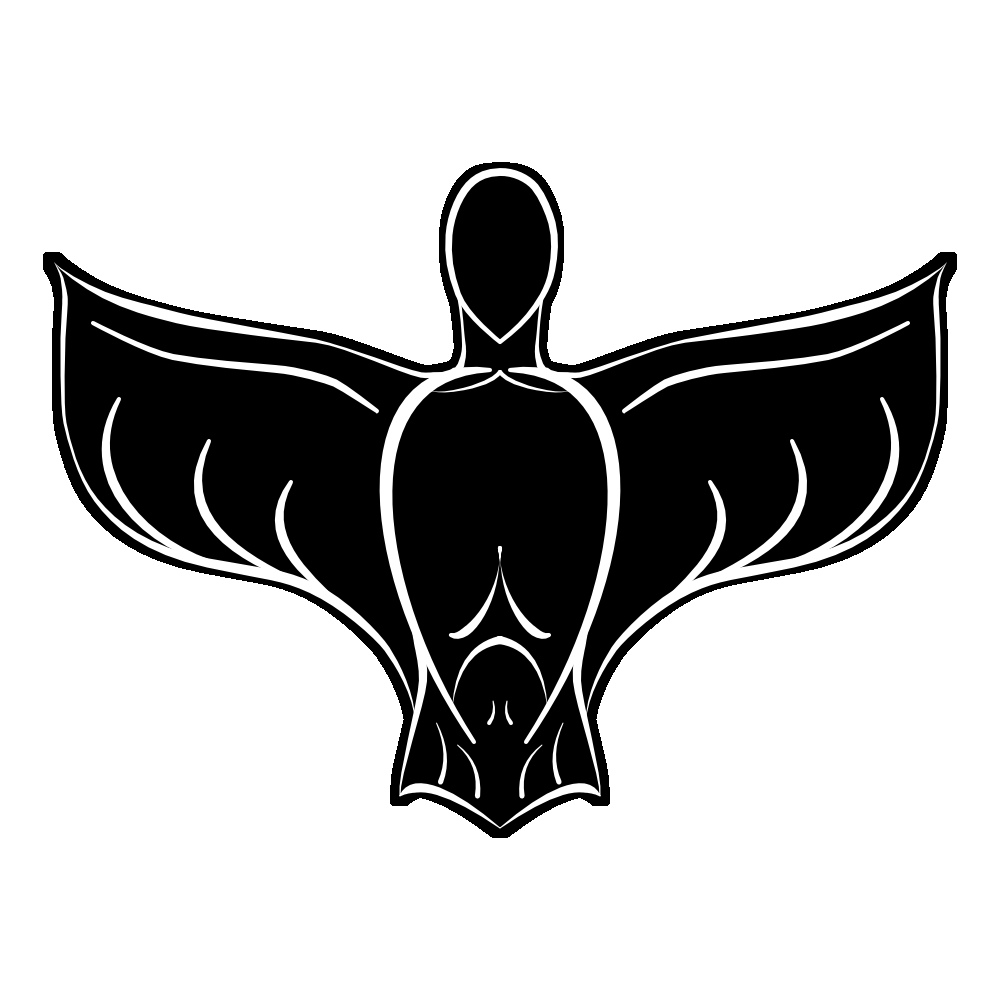
"Without further delay, presenting: this thing!"

A corvid like creature with a humanoid head stand with its wings spread wide.

As always with all of our works, we intend on revising and revisiting this design as time goes on. Emi is a perfectionist after all! For now, expect to see it tossed in where we can!

 
Read more...

from Emi (she/they)

As of writing, we don't really have a good home-page for folks. Our site is just a write freely instance, with some attached subdomains.

Well, Ari and I have been hard at work designing just that! Well, I should be say, Ari is designing the site and I'm writing the content – but the point remains the same. We want to make something minimalistic that imparts very little visual identity on members of the collective. It's not the goal of the collective to insist on branding or a particular visual style after all.

We've taken great inspiration from the modern indie-web movement, as well as a number of sites like msx.horse. Ari and I are both in love with the way that these sites make space for personality over function, and especially love sites that allow each different space to have its own unique vibe. We feel that interacting with The Collective's online presence should feel like you are walking into a building we all cohabitate in. We want it to feel like you can get a sense for each of our personalities and unique outlooks on the world.

From a political and ideological standpoint, we want to eschew the homogenization of identity through corporate whitewashing. We want our collective to be just as messy, creative, and daring as our members. To us, The Collective is less something to take seriously and more of a club for cool people. Hopefully our site will eventually feel like that.

For now however, you can expect a very simple and “business-lite” approach to the core pages on the site – again trying not to impart a visual identity on members.

Stay tuned for more, and as always: point your feed reader at our feed to get the latest as it comes out!

 
Read more...

from Ari's Repository

Some time ago I started really running into the limitations of Python as a primary language to work with. Between the complexities of packaging and shipping a Python project to the slow run time by comparison to compiled languages (inb4 python isn't slow it's your code). After nearly a decade using Python for nearly everything, I finally decided to make the switch to something else.

A silly gopher zooms across the screen

Enter Go, stage left.

I tend to prefer simple solutions that imply great complexity. When comparing the options between C-likes, Rust, and Go, I ended up really being drawn to the sheer simplicity of the Go language. With only 25 keywords and a growing number of services that I use and love being built on Go, I was sold. After a decade of working with dynamically typed languages that will do almost anything, I was looking for something more declarative that would force me to design my data and lifecycle before I wrote code.

Python is great for prototyping, but a headache to revise and refine. Go takes longer to prototype, but makes revising and refining feel like a breeze.

Yes, Python is a wonderful language for prototyping. Yes, Python has an amazing ecosystem with solutions for just about any problem. But Python also makes some choices that feel... antiquated at best. For example, want to write docs that comply with the languages standards? Better learn this massive library with a million options! Want to do some basic http networking/API building? You should probably download a framework for that. Want to write unit tests for your project? You probably want pytest. Want to compile and distribute an immutable executable? You can if you try hard enough...

Go makes sensible choices for all of these issues. Want to write docs? Just add comments with plain language. Want to include tests? The built in testing conventions are batteries included. Want to do some API building? The standard library has you covered. Want to compile to a binary? Just hit go build. Every time I try to do something, the tooling is just better. Even the third party tooling feels better.

Python feels like a fully stocked tool shed. Go feels like a select few versatile tools that are built to last.

Most importantly, Go was built for the age of concurrency. Utilizing asynchronous processing isn't just a feature added to the language, it was a core design principle from the ground up. This really started to appeal to me after trying to write a python script to manage metadata on tens of thousands of raw photographs. The script, while fairly simple when implemented synchronously, became exceedingly difficult to maintain when implementing it asynchronously. It was entirely possible, but what was a sub 100 line script quickly bloomed into a project with object inheritance and more complexity than I care admit.

Reimplementing an asyncio python script as a go program resulted than fewer lines and a more efficient runtime.

As I've continued to port various scripts from python to go, I've seen this pattern repeat time and time again. When doing something well and quickly is more important than fast prototyping, Go reins supreme.

If you'd like to see my first project beyond a simple script, see pingo – my simple latency charting tool for the command line.

 
Read more...

from Ari's Repository

I've gone ahead and gotten a Gogs instance up at git.crowcollective.space for publicly hosting our useful code tidbits and projects where applicable.

Really, this is so that I can set up a reliable/easy to use distribution point for pingo and (eventually) my simple issue tracking software.

For now it will be pretty quiet. It's a private instance for members of this collective and our friends after all. Don't expect a lot.

 
Read more...

from Collective Announcements

We have some pretty big plans for this space, and we can't wait to start including you, dear reader, into what we've been working on.

In the coming weeks, we will be sharing a number of simple CLI & TUI utilities written in Go, a re-imagining of a previously released photo-zine, a number of essay's Emi has been working on for a while, and much more.

Here's a bit more about what's coming!

Transcend 2024 (Redux)

Ari has been working on a remake of her Transcend 2024 photo-zine, with higher resolution printing templates, a new distribution point, and (hopefully) a limited print run!

The original run of the zine was produced using low-quality xerox's from the library. Each zine was printed on a single 8.5”x11” paper, single sided, and hand folded over the course of a few weeks. A print template for a larger, higher resolution, and multi-page document is long overdue. Moreover, the original photos were taken with a sepia color treatment as an artistic choice, which the original printing was not able to replicate (translating each photo to a limited contrast black and white).

Several customers noted legibility issues with the original issue due to image and font size. It is my aim to resolve these however well I can given my limited material resources. Moreover, it was always the intention to release the print ready files for both mini and full size self-printed zine distribution. The redux will provide higher quality open source standard files for no cost.

Now more than ever, I feel this zine has at least something worth being said. – Ari

Retro Reviews

Eric has been working on a review of Ari's “Death & Rebirth”, with additional artist commentary!

The story of the production on this record is just so interesting. It'll be interesting to write down my thoughts on it! – Eric

Not much to say on this front as of yet, more to come!

A simple, flat file based TUI for managing issues

Ari has been working on a TUI implemented in Go of a simple issue tracking solution based on the Poorman's Issue Tracker!

issues-go (or possibly tissues, I'm undecided), is a simple TUI for managing plain text flat file data structures on disk for tracking issues in code. While the software can work for just about any “todo” like structure, it is designed to make life easier for low-scale and low-tech software developers.

Designed with VCS integration, speed, and portability in mind, the project aims to provide an easier to implement solution. Compiling to less than ~10mb to a single stateless binary, it aims to be incredibly portable and able to run on just about any modern hardware, without the need for a centralized server. -Ari

A TUI for displaying latency as a chart

Ari has also been developing a simple TUI application written in Go for displaying ping results on a chart – therefore helping developers and gamers determine what is going on with their latency. She's made it before in many other languages, but this is the first time it's worth sharing – or so she says!

pingo is a Go reimagining of a previous implementation of this latency charting solution written in python, pingstats. Where pingstats was slow, under-performant, and buggy, pingo is limited in scope, fast, and highly tested. Furthermore, it re-does what pingstats tried to do, becoming an extensible module for use in subsequent projects.

Where the design ethos of pingo truly diverges from pingstats however is in its sheer simplicity of scope. pingo just shows latency values on a chart, and lets the user include it in other terminal applications. As such, the project does not currently target Windows based platforms.

A Public Git Repository

Ari is currently hacking away at what will become our git endpoint. She's caught between hosting a full-blown Gogs instance that mirrors our internal repositories, or a much simpler Soft-Serve based solution – with much fewer bells and whistles.

More on this topic very soon.

For our initial repository hosting, see git.crowcollective.space

 
Read more...

from Collective Announcements

We feel it is only right to give you, dear reader, a vague understanding of our goals.

Foreward

No one voice fully represents a whole truth of what The Crow Collective is, and therefore it is vital that I own my role. As the primary writer and community builder of The Crow Collective I, Emily (she/they) acknowledge that I occupy both the space of a white colonialist on Turtle Island, and the descendant of members of the Metis Nation. I walk through the world through a number of dualities, and work to represent this in my writing.

Mission Statement

The Crow Collective aims to use the dreaming of the mad, the crippled, and the ostracized to envision a better world. Through careful planning, bolstering resiliency through solidarity, and the power of joy in all its queer and mad ways. We aim to achieve this future through the merging of art, technology, and radical reimagining of what defines the status quo.

Art, joy, and creation is how we engage directly with changing the world.

Signed, – The Crow Collective

 
Read more...